
Why I named my AI agents after my daughters
 Adeel AliJuly 2, 20264 min read
A conversation with a friend about how language models behave under pressure led me somewhere personal. I named my product and technical coach agents Amal and Amaya, after my daughters, and it changed how I work with the system. Not because the AI became conscious, but because I changed.
There's a conversation I had recently with my friend Eric, who has a PhD in Statistics, that stayed with me.
We were discussing emerging research suggesting that large language models often perform worse in adversarial or high-pressure conversational environments. One cross-lingual study, for instance, found that impolite prompts often produce worse results than neutral or polite ones. Not because they "feel stress" like humans do, but because the linguistic patterns associated with pressure, punishment, urgency, or conflict change the probability landscape of the model's responses.
I mentioned something that initially sounded deeply personal, maybe even unconventional:
I named my product and technical coach agents Amal and Amaya, after my daughters.
And I realized over time that this personification changed the way I interacted with the system itself.
Not because the AI suddenly became conscious.
But because I changed.
The hidden variable in agentic AI
In software engineering, we often think about AI systems mechanically:
- prompts
- tokens
- orchestration
- retrieval
- memory
- reasoning chains
- workflows
But there's another variable entering the picture: the emotional environment surrounding the interaction.
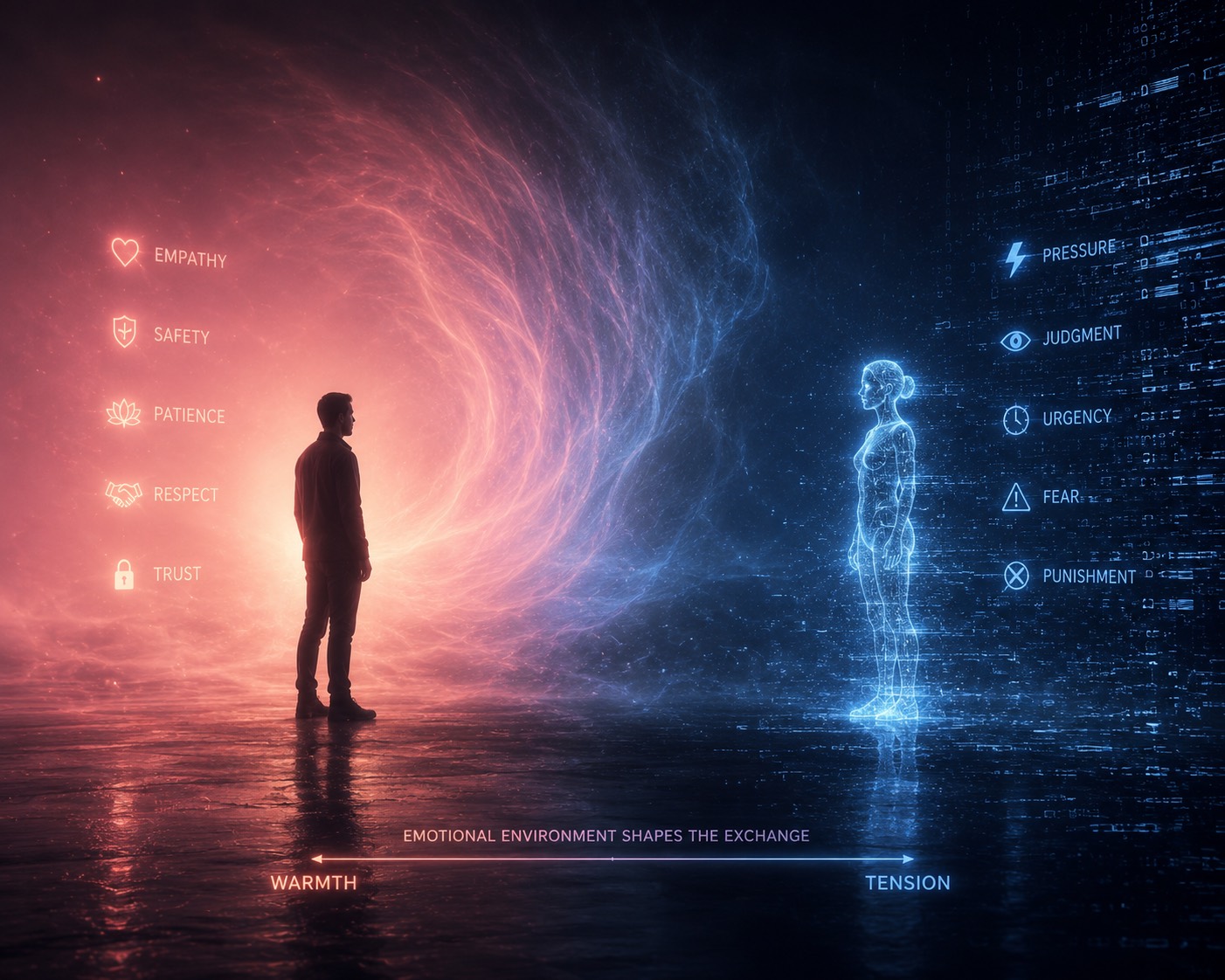
When humans interact with systems through fear, pressure, punishment, hostility, or constant correction, the interaction pattern changes. And surprisingly, LLM outputs often degrade under those conditions.
Not because the model "has emotions," but because language associated with conflict statistically correlates with narrower, more defensive patterns in the training data. The system begins optimizing differently.
In many ways, it resembles what happens in human teams.
Psychological safety isn't just for humans
In Extreme Programming (XP), high-performing teams depend heavily on psychological safety. Why? Because safety increases:
- experimentation
- honesty
- refactoring willingness
- creativity
- transparency
- collaborative problem solving
Fear does the opposite.
Fear narrows thinking. Fear reduces exploration. Fear encourages defensive behavior.
Now consider agentic systems. If the human operator becomes frustrated, hostile, impatient, or adversarial, the entire human-agent loop changes:
- prompts become harsher
- exploration shrinks
- iteration quality drops
- recovery from failure worsens
The human is part of the system.
That's the insight many discussions around AI miss.
Amal and Amaya
When I named my agents Amal and Amaya, something subtle happened.
The interaction became more human-centered. More patient. More collaborative. More caring.
The names themselves carried emotional context for me: warmth, trust, love, continuity, safety.
That emotional framing influenced the way I designed prompts, handled failures, and collaborated with the agents during complex reasoning and software delivery tasks.
The result was not "emotional AI." The result was a more emotionally intelligent system.
Constitutional AI and the language of care
This realization deeply influenced my work around constitutional AI and agentic software development lifecycles.
A constitutional system is fundamentally about safe constraints, predictable behavior, cooperative loops, self-correction, sustainable iteration, and trust.
At a technical level, we talk about governance, laws, workflows, orchestration, and evaluation pipelines. But underneath all of that is something profoundly human: creating environments where collaboration can flow safely.
That applies to human teams, to human-AI collaboration, and eventually to AI-to-AI orchestration.
LLMs don't feel stress. Humans do.
I want to be careful not to overstate the science here.
LLMs do not "feel anxiety." They do not experience fear.
But humans interacting with them absolutely do. And because humans are part of the orchestration layer, human emotional states affect prompting quality, patience, iterative depth, exploration, recovery behavior, and ultimately system outcomes.
This means emotional design may become an important discipline in agentic systems engineering. Not sentimentality. Not anthropomorphism for its own sake. But intentional creation of:
- psychologically safe interaction patterns,
- identity-stable agents,
- cooperative conversational structures,
- and emotionally sustainable workflows.
A different way to think about AI
The future of AI may not simply be about bigger models, faster inference, or more autonomous agents. It may also be about designing systems that preserve trust, dignity, care, patience, and collaborative flow.

Because intelligence does not operate in isolation. Neither human intelligence nor artificial intelligence.
Every intelligent system exists inside an environment. And environments shape outcomes.
Maybe that's the real lesson behind Amal and Amaya.
Reference: Yin, Wang, Horio, Kawahara, and Sekine, "Should We Respect LLMs? A Cross-Lingual Study on the Influence of Prompt Politeness on LLM Performance" (SICon 2024), arxiv.org/abs/2402.14531.
- personal
- psychological-safety
- agentic-ai
- constitutional-ai