
Your AI can code. But can it build software?
 Adeel AliFebruary 3, 20267 min read
Everyone is using AI to write code. Most of what it produces does not hold up. The gap is not talent, it is discipline. Here is the framework we built to give an AI agent the way your organization actually builds software: a constitution, skills, workflows, and avatars.
Everyone is using AI to write code now. But here is what nobody is talking about: most of it does not hold up.
Teams ship faster while quality drops. Developers produce more code and understand less of it. Technical debt piles up at a pace we have not seen before. The promise was productivity. The reality, for a lot of teams, is chaos at scale.
At ClickChain AI we asked a different question. What if the AI did not just generate code, but actually knew how to build software the way your organization builds software?
That is the framework this post is about.
The problem nobody wants to admit
AI coding tools are everywhere, and they are impressive, right up until you look closely.
Ask an AI to build a feature and you will get code. A lot of code. But does it follow your company's standards? Does it have real tests? Will it scale? Is it secure? Usually the honest answer is no.
That is because today's tools are skilled but undisciplined. They know how to write code. They do not know how your organization builds software. It is like hiring someone who graduated top of their class and has never worked a real job. Talented, not yet effective.
What if the AI came pre-trained on your best practices?
Imagine onboarding a developer who already knew your coding standards, wrote tests before code, understood your industry's compliance requirements, reached for the right patterns for your stack, and could take a feature from idea to production without being told each step.
That is what we set out to build. The framework has four layers.
Constitution. The governance layer. Engineering principles, product practices, and business rules that the work has to satisfy. Some are marked non-negotiable, which means no single person and no agent gets to waive them in a hurry.
Skills. Proven capabilities like test-driven development, API design, and security review. Each skill encodes a methodology, not just a shortcut.
Workflows. End-to-end processes that chain skills together, from discovering what users actually need to shipping a tested, documented feature.
Avatars. Context adapters for your specific situation. React or Python, healthcare or fintech, B2B or consumer: there is an avatar that knows your world and applies it automatically.
Think of it like a franchise system
Here is an analogy that helps. McDonald's does not win because it hires great chefs. It wins because it has systems. Every location follows the same processes, uses the same equipment, and produces consistent results whether you are in Tokyo or Toronto.
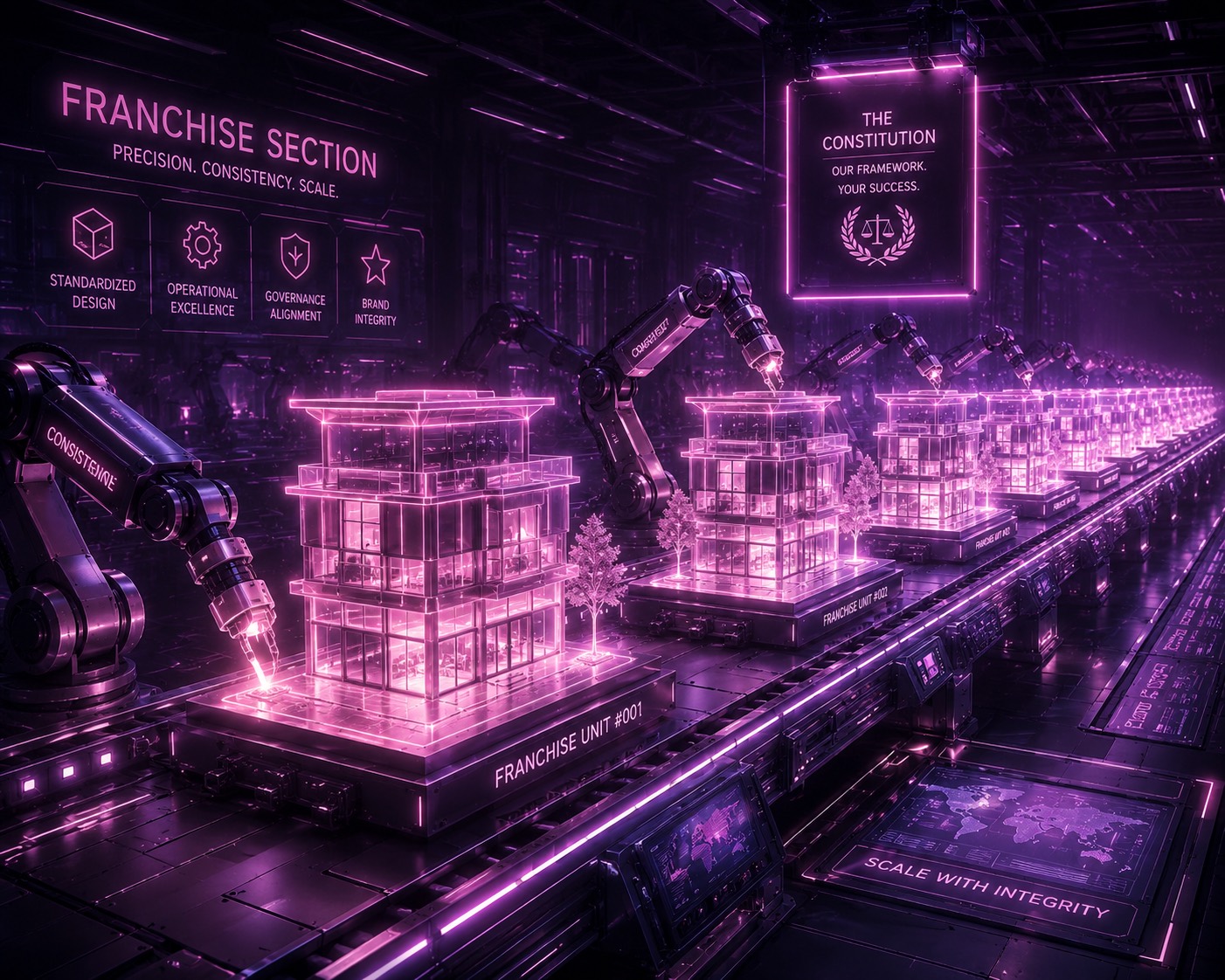
The framework does the same for AI-assisted development. Skills are the standardized recipes. Workflows are the kitchen procedures. Avatars adapt for local tastes and regulations. The constitution makes sure every location meets the quality bar. The result is the same quality output whether it is your senior engineer or a fresh model doing the work, in Tokyo or Toronto.
Skills: what your AI can actually do
We have built skills across the whole software development lifecycle, and we keep expanding them as we build for clients:
| Lifecycle stage | Skills |
|---|---|
| Discovery and planning | roadmapping, user journey mapping, business rules |
| Specification | executable specs, domain modeling |
| Implementation | atomic TDD, vertical slice development, code review, refactoring |
| Operations | security review, incident response, API design, observability, technical debt management |
| Data and ML | ML pipeline design, experiment tracking, model serving, ML monitoring |
| AI development | prompt engineering, RAG architecture, AI agent design, AI safety |
| UX and design | UX design systems, design-to-code automation |
Each skill is a methodology, not just a capability. When the AI uses atomic TDD, it does not simply write some tests. It follows a proven cycle: one failing test, the minimum code to pass it, a refactor, a quality check, then commit, then repeat.
Here is the difference in practice. A developer says, "I need to add a payment feature." Without the framework, the AI dumps hundreds of lines of code and hopes for the best. With the framework, it responds: "Let me build this as a vertical slice, end to end, with atomic TDD so every behavior is tested. What is the first user action we should handle: entering card details, or processing the payment?" Same model. Completely different approach.
Avatars: your context, built in
Universal best practices are great, but every team operates in a specific context. That is what avatars are for.
| Avatar type | What it carries | Examples |
|---|---|---|
| Technology | the patterns of a stack | React/TypeScript, Python/FastAPI, Java/Spring, .NET Core, Node.js, React Native, data engineering, PyTorch/TensorFlow, LangChain, vector databases |
| Industry | the rules of a domain | healthcare/HIPAA, financial services/SOX/PCI-DSS, government/FedRAMP, aviation safety-critical, education/FERPA, defense |
| Product-type | the shape of what you build | B2B SaaS, B2C offline-first, marketplace, platform API, internal enterprise |
Tell the AI you are building a healthcare B2B SaaS product in Python, and it loads the relevant avatars and applies healthcare compliance, SaaS patterns, and Python conventions together, without you spelling each one out.
What this looks like in practice
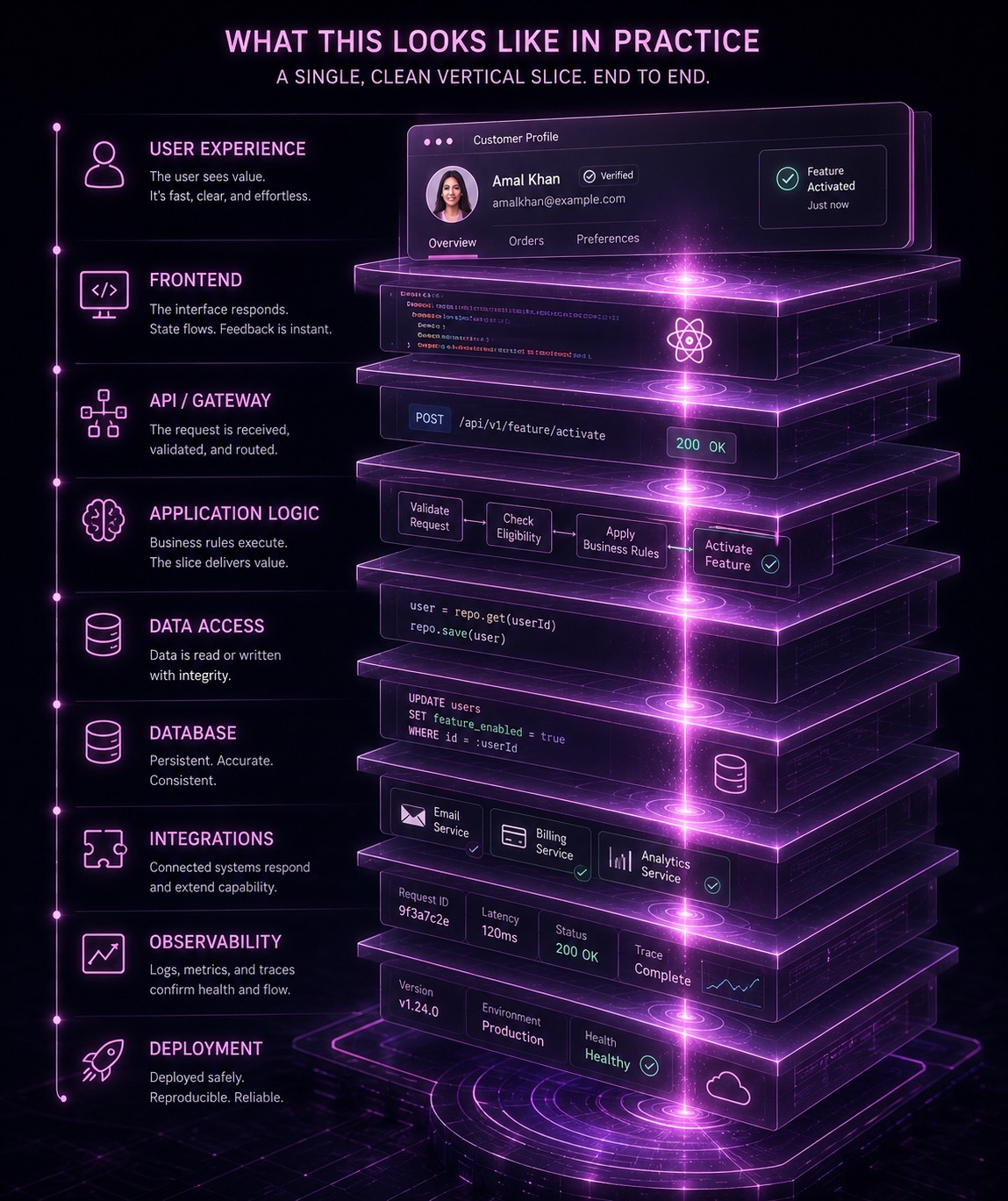
Let me walk through a real scenario.
The request: "Our users are abandoning their carts because shipping costs surprise them at checkout."
Without the framework: a developer asks the AI to add shipping estimates. It generates code. The edge cases are not handled, so they rewrite. It was not tested, so tests get bolted on after. It does not meet accessibility requirements, so that gets patched. It ships. Then the support tickets about wrong estimates start.
With the framework, the AI opens with discovery: "Before we build anything, where in the journey does this surprise happen, and what do users see now versus what would help?" Then specification: "Here is what we are building. When a user views their cart they see an estimated shipping cost for their location, and they can update their zip code for an accurate estimate. Does that capture it?" Then it builds test-first: "I will start with the simplest case, showing an estimate for a known location, and write that test before the code." Then it verifies: "Tests passing, coverage looks good, security review clean, accessibility met. Ready to ship."
- 1. Dump hundreds of lines
- 2. Discover missing edge cases
- 3. Bolt on tests after
- 4. Patch accessibility
- 5. Support tickets arrive
- 1. Understand the problem
- 2. Specify the behavior
- 3. Write the test first
- 4. Verify against the laws
- 5. Ship with confidence
The difference is not speed. It is method.
The AI follows the same disciplined path a senior engineer would, because that is what the skills encode.
Continuous evolution
The framework is not a finished product. It gets sharper every time we ship for a client. Recent additions like ML pipeline design, RAG architecture, and AI safety were not planned in advance, they came out of real builds and got encoded so the next team inherits them. That is what it means to treat AI development as a discipline instead of a tool.
Amplify your best practices, or scale your worst habits
We are at an inflection point. Every company is adopting AI coding tools. Some are shipping faster while quality quietly degrades. A few are using AI to amplify their best practices instead of replacing their thinking. The gap between those two groups is going to define the next decade of software.
The honest goal we hold ourselves to is not a productivity number on a slide. It is this: when a developer works inside the framework, they should come out a stronger engineer, not a more dependent one. Amplification, not replacement.
The question was never whether to use AI for software development. That ship has sailed. The real question is whether AI will amplify your best practices or scale your worst habits. Constitution provides the governance. Skills provide the capability. Workflows provide the process. Avatars provide the context. Together they turn AI from a tool you hope works into a partner you can trust.
If you want to see it run on your code, book a walkthrough and we will show you.
Adeel Ali is the founder of ClickChain AI, where teams use AI to amplify their best engineers instead of replacing their judgment.
- framework
- governance
- agentic-sdlc
- avatars